
A promotional interview featuring Canadian actor Maitreyi Ramakrishnan discussing her Tamil identity has ignited a wide-ranging online debate about cultural representation, the history of Bharatanatyam, and who can authentically engage with Tamil artistic traditions. The conversation erupted around Netflix’s dance film Best of the Best, in which Ramakrishnan stars, and quickly expanded beyond the movie itself into questions of diaspora identity, classical dance heritage, and the boundaries of cultural ownership.
The Clip That Sparked the Discussion
In interviews promoting Best of the Best, Ramakrishnan spoke candidly about her background. Born and raised in Mississauga, Ontario, she is the daughter of Tamil parents who left Sri Lanka as refugees during the civil war. She has long identified as Tamil Canadian and, more specifically, as a Tamil Eelam woman, distinguishing her cultural identity from both Indian nationality and a simple “Sri Lankan” label. She has stated that Canada is her country while Tamil culture remains central to who she is.
When a clip of these remarks circulated on X, some users questioned her presence in a film centred on Bollywood-fusion dance and her performance of Bharatanatyam sequences. Critics asked why a performer of Sri Lankan Tamil heritage was representing or participating in forms they associated primarily with Indian cultural production. Others responded that Bharatanatyam has deep historical roots in Tamil culture and that restricting a classical art form according to modern national borders misunderstands both history and the lived reality of the Tamil diaspora.
Bharatanatyam and Questions of Ownership
The debate rapidly moved from Ramakrishnan’s casting to the nature of Bharatanatyam itself. Participants pointed to the dance form’s origins in Tamil Nadu, its connections to temple traditions and the devadasi community, and its later formalisation and popularisation in the twentieth century through figures such as Rukmini Devi Arundale. Some argued that the dance belongs first to Tamil cultural continuum and therefore remains accessible to Tamil people regardless of whether their families are from India or Sri Lanka. Others maintained that its contemporary institutional and popular associations are heavily Indian and that casting and framing in a global streaming film carry different representational weight.
This exchange revealed how classical arts often become flashpoints in discussions of identity. For many in the diaspora, engagement with Bharatanatyam, language, or folk forms such as kuthu serves as a way of maintaining cultural continuity across generations and geographies. For others, the visibility of non-Indian performers in spaces coded as “Indian” in Western media raises concerns about opportunity, accuracy, and the flattening of distinct South Asian identities.
Ramakrishnan’s Position and Preparation
Ramakrishnan has been consistent about her identity since the beginning of her public career. She has rejected being labelled simply as Indian or Sri Lankan when those terms do not reflect her self-understanding, while affirming the centrality of Tamil culture. In the context of Best of the Best, she underwent months of intensive dance training that included Bharatanatyam, Kathak, hip-hop, and other styles. She has described the process as demanding and has spoken about the responsibility she felt not to misrepresent traditions she admires.
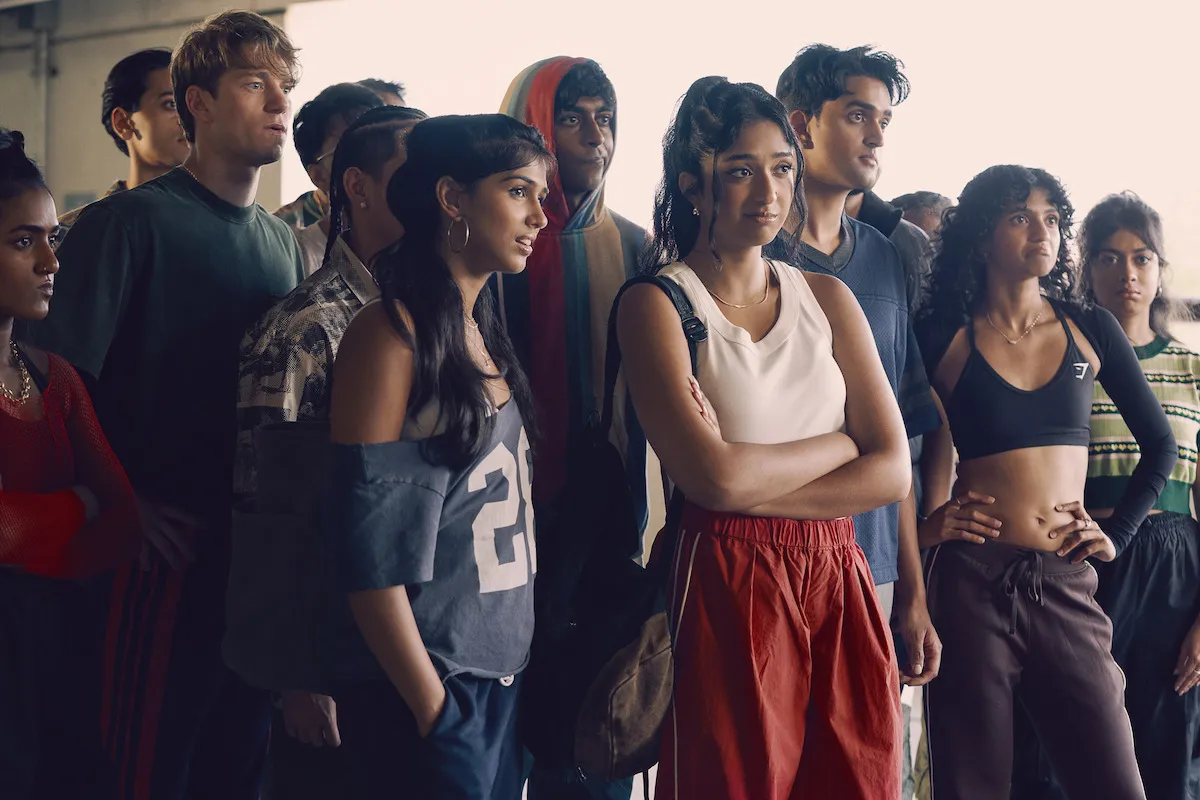
She has also discussed performing kuthu on set and the emotional impact of seeing Tamil cultural expression included in a mainstream Netflix production. For her, these elements appear to function as both personal connection and broader representation for Tamil audiences who rarely see their specific cultural references on global screens.
Broader Context of the Film and Prior Controversy
Best of the Best follows two friends who join a competitive collegiate Bollywood-fusion dance team. The film sits at the intersection of diaspora experience, campus life, and the global popularity of Indian film dance styles. Its release had already attracted criticism over a dialogue that compared unwanted male attention to “the last plane out of Kabul,” a line many viewers found tone-deaf or offensive.
The identity and Bharatanatyam debate added another layer. Some framed the issue as one of Hollywood’s tendency to cast mixed or non-Indian South Asian actors in roles perceived as Indian, thereby limiting opportunities for performers from specific communities. Others saw the criticism as an overly rigid policing of cultural boundaries that ignores the shared linguistic, artistic, and historical ties among Tamil populations across the region and the diaspora.
Diaspora Identity and Cultural Continuity
At its core, the discussion reflects ongoing negotiations within diaspora communities about authenticity, belonging, and representation. Tamil populations exist in India, Sri Lanka, and across Canada, the United Kingdom, Malaysia, Singapore, and elsewhere. Political histories, particularly the Sri Lankan civil war and its aftermath, have shaped how many Eelam Tamils articulate their identity in relation to the Sri Lankan state. At the same time, classical and folk arts have travelled with communities and evolved in new settings.
When a prominent young actor of Tamil Eelam heritage appears in a high-visibility project performing Bharatanatyam and speaking openly about her background, these complex layers surface publicly. The resulting arguments are rarely only about one performer or one film. They become proxies for larger questions: Who inherits cultural forms? How should global media depict internal diversity within broad labels such as “South Asian” or “Indian”? And how do second-generation diaspora artists balance personal identity with the expectations of multiple audiences?
A Conversation Larger Than One Clip
The intensity of the online exchange demonstrates how quickly questions of casting and cultural reference can expand into examinations of history, politics, and belonging. Bharatanatyam’s journey from temple and court traditions to concert stage and cinema already involves multiple reinterpretations. Its appearance in a Netflix dance comedy performed by a Tamil Canadian actor of Sri Lankan family origin simply adds another chapter to that ongoing story.
Ramakrishnan’s insistence on naming her identity precisely, combined with her visible effort to train in the dance forms required by the role, has forced a more nuanced conversation than simple accusations of appropriation or exclusion usually allow. Whether the debate ultimately encourages more careful representation, broader opportunity, or simply greater awareness of Tamil diversity remains to be seen. What is clear is that a promotional interview for a dance film has opened a window onto deeper and unresolved questions about culture, nation, and the arts in a globalised media landscape.
Read more – wellposhan.com