
In the second chapter of the Bhagavad Gita, Lord Krishna offers Arjuna a clear and memorable image to explain the nature of the self. Verse 22 states that just as a person discards worn-out clothes and puts on new ones, the embodied soul leaves an old body and takes up another. The teaching presents death not as destruction but as a transition, and it underlines the eternal character of the soul.
The Verse in Context
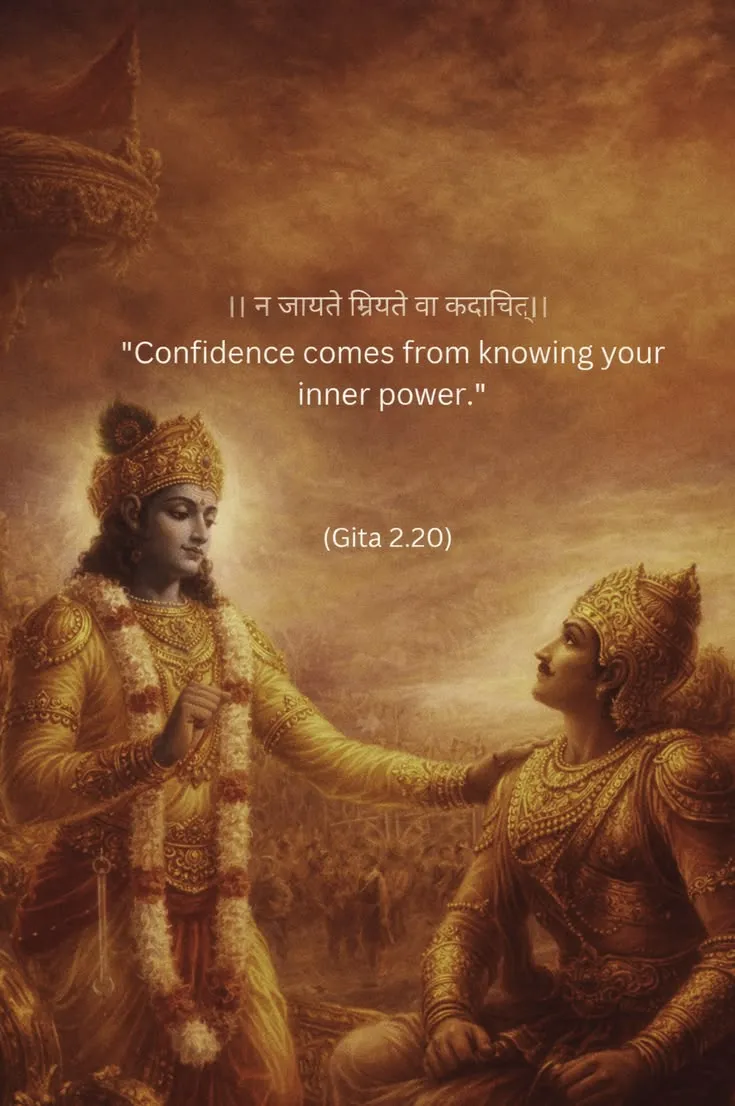
The conversation takes place on the battlefield of Kurukshetra. Arjuna is overwhelmed by the prospect of fighting his own relatives and teachers. He lays down his bow, overcome by grief and moral confusion. Krishna responds by shifting Arjuna’s attention from the temporary body to the enduring self.
Chapter 2 systematically distinguishes the body from the soul. Earlier verses establish that the soul is never born and never dies, that it is unchanging and indestructible. Verse 22 then supplies a concrete analogy that makes the abstract teaching accessible. The Sanskrit runs:
Vāsāṁsi jīrṇāni yathā vihāya navāni gṛhṇāti naro ’parāṇi;
tathā śarīrāṇi vihāya jīrṇāny anyāni saṁyāti navāni dehī.
A widely accepted English rendering is: Just as a person casts off worn-out garments and puts on new ones, so the embodied soul casts off worn-out bodies and enters others that are new.
The Force of the Analogy
Clothes are external to the person who wears them. They become frayed with use, lose their usefulness, and are set aside without the wearer himself being diminished. New garments are then taken up according to need and circumstance. The person remains the same throughout the change.
Krishna applies the same logic to the relationship between the soul and the body. The body is subject to birth, growth, decay and death. When it is no longer fit for the soul’s journey, it is left behind. The soul, referred to in the verse as dehī—the embodied one—moves on to another form. The continuity of identity belongs to the soul, not to the physical frame.
The analogy is deliberately ordinary. Changing clothes is a familiar, non-traumatic act. By linking death to something so everyday, the Gita removes much of the terror that usually surrounds the end of physical life. The process is presented as natural rather than catastrophic.
What the Teaching Affirms
Several core ideas follow from the verse. First, the soul is distinct from the body. The body is an instrument or covering; the soul is the conscious entity that uses it. Second, the soul is continuous. It does not cease when one body ends. Third, death is a transition rather than an absolute end. The departure from one form is followed by the assumption of another, in keeping with the larger framework of rebirth that the Gita accepts.
The verse also carries an ethical implication for Arjuna’s immediate situation. If the true self of those who die in battle is not destroyed, then the act of fighting, performed as duty, does not constitute the annihilation of persons. The bodies may fall, but the souls continue. This understanding is meant to free Arjuna from paralysing grief so that he can act according to his responsibility as a warrior.
Attachment and Identity
Human beings commonly identify with the body—its appearance, strength, relationships and social roles. When the body weakens or dies, that identification produces intense sorrow. The Gita’s clothing metaphor challenges this habit of identification. Just as a person does not consider himself destroyed when he changes garments, the wise do not regard the self as lost when the body is set aside.
This shift in perspective is intended to cultivate detachment. Detachment here does not mean indifference to life. It means recognising that the deepest identity of a person is not exhausted by any single physical existence. Such recognition can bring equanimity in the face of both personal mortality and the mortality of others.
Continuity Across Traditions of Interpretation
Commentators from different schools have found the verse consistent with their broader philosophies while preserving its central claim. The soul is the unchanging occupant; the body is the changing covering. Whether the discussion turns on the precise metaphysical status of the individual self or on the mechanics of rebirth, the basic teaching remains: the self is not terminated by the death of the body.
The simplicity of the image has helped the verse remain one of the most frequently quoted passages in the Gita. It requires no specialised philosophical vocabulary. Anyone who has ever replaced an old garment can grasp the comparison and, through it, the assertion that the soul continues.
Living with the Insight
The practical value of the teaching lies in how it reframes ordinary experience. Ageing, illness and the eventual loss of the body are no longer seen as the destruction of the person. They are changes of covering. This does not eliminate the need for care, responsibility or grief, but it places those experiences within a larger continuum.
For Arjuna, the verse formed part of a larger argument that restored his capacity to act. For later readers, it continues to serve as a reminder that the self is more enduring than any single form it inhabits. The body is temporary; the soul is not. Death changes the clothing, not the wearer.
In this way, Bhagavad Gita 2.22 offers both consolation and clarity. It addresses the fear of annihilation by asserting continuity, and it does so through an image so ordinary that its force is immediately felt. The soul leaves one body and takes another, just as a person leaves old clothes and puts on new ones. The teaching stands as one of the Gita’s most direct statements on the eternal nature of the self.
Read more – situsmerahtoto.info