
Bodyweight exercises offer an accessible and effective way for beginners to build strength, improve balance, and increase flexibility without equipment or a gym. These movements use the body’s own resistance, making them suitable for home workouts and easy to modify according to current ability. When performed with attention to form and consistency, they develop functional fitness that supports everyday activities and reduces the risk of injury. This guide covers foundational exercises that deliver results across strength, stability, and mobility.
Why Bodyweight Training Works Well for Beginners
Starting with bodyweight movements allows new exercisers to master proper technique before adding external load. These exercises improve muscular endurance, joint stability, and body awareness. Many also challenge balance and encourage a greater range of motion, addressing flexibility alongside strength. Public health and fitness guidelines support regular muscle-strengthening activities at least twice per week, and bodyweight options make meeting this recommendation practical. Progress occurs by increasing repetitions, slowing the tempo, or advancing to more challenging variations once basic versions feel controlled.
Foundational Lower-Body Strength: Squats and Glute Bridges
The bodyweight squat is one of the most functional exercises for beginners. It strengthens the quadriceps, glutes, and core while training the pattern used in sitting and standing. Stand with feet roughly shoulder-width apart, toes pointing slightly outward. Initiate the movement by pushing the hips back as if sitting into a chair, keeping the chest lifted and knees tracking in line with the toes. Lower to a comfortable depth, then drive through the feet to return to standing. Begin with supported squats using a chair for balance or depth control if needed.
Glute bridges target the posterior chain, which is often underused after prolonged sitting. Lie on the back with knees bent and feet flat on the floor. Press through the heels to lift the hips until the body forms a straight line from shoulders to knees, squeezing the glutes at the top. Lower with control. This movement builds hip strength and stability while remaining gentle on the spine when performed correctly.
Upper-Body Strength: Modified Push-Ups
Push-ups develop the chest, shoulders, triceps, and core. Beginners should start with wall push-ups or knee push-ups to build capacity safely. For wall push-ups, place hands on a wall at shoulder height and walk the feet back to a comfortable angle. Lower the chest toward the wall by bending the elbows, then press away. Knee push-ups are performed on the floor with knees grounded and a straight line from head to knees. Focus on keeping the core engaged and avoiding sagging or piking at the hips. Full push-ups can be introduced once multiple controlled repetitions of the modified versions are possible.
Core Stability: Planks and Bird-Dog
A strong core supports balance and protects the spine during daily movement. The plank trains endurance in the abdominals, back, and shoulders. Begin with a modified version on the knees or with hands elevated on a sturdy surface. Maintain a straight line from head to knees or heels, avoiding collapsed hips or raised buttocks. Hold for short periods, breathing steadily, and rest as needed.
The bird-dog improves core stability and coordination. From a hands-and-knees position, slowly extend one arm forward and the opposite leg backward while keeping the torso steady and hips level. Return to the starting position and alternate sides. This exercise enhances balance and teaches controlled movement through the spine and pelvis.
Balance Training: Single-Leg Stands and Heel-to-Toe Walks
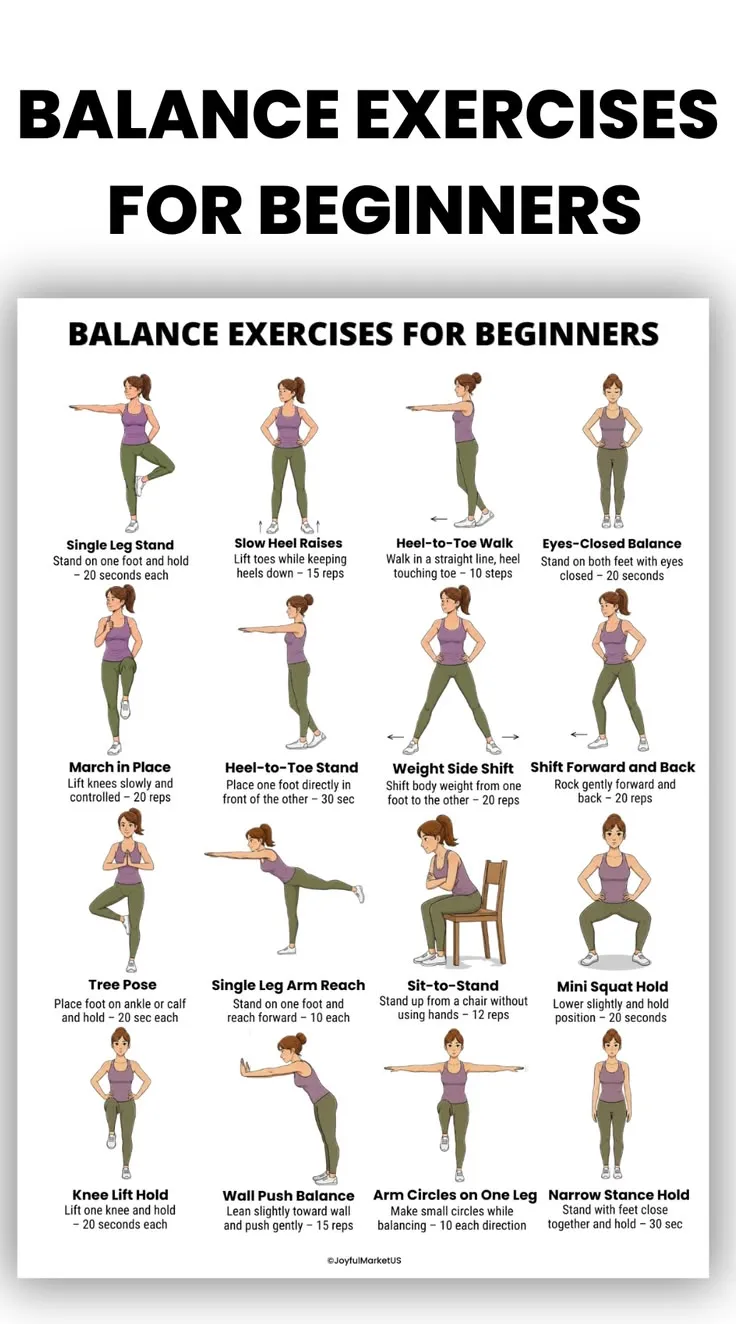
Balance declines when not challenged, yet it can be improved with simple practice. Supported single-leg stands are an excellent starting point. Stand near a wall or chair and lift one foot slightly off the floor, holding the position while maintaining upright posture. Switch sides. As stability improves, reduce reliance on support and increase hold time.
Heel-to-toe walking, also called tandem walking, further develops balance and proprioception. Walk in a straight line, placing the heel of one foot directly in front of the toes of the other. Keep the gaze forward and use a wall for light support if necessary. These drills strengthen the smaller stabilizing muscles of the ankles, hips, and core.
Flexibility and Mobility: Cat-Cow and Gentle Hip Openers
Flexibility improves when joints move regularly through comfortable ranges. Cat-cow is a gentle spinal mobility exercise performed on hands and knees. Alternate between arching the back and lifting the chest (cow) and rounding the spine while tucking the pelvis (cat), moving with the breath. This encourages thoracic and lumbar mobility.
Simple hip flexor stretches help counteract the shortening that occurs from sitting. In a half-kneeling position, gently shift the weight forward while keeping the torso upright until a stretch is felt in the front of the back hip. Hold without forcing the range. Consistent mobility work complements strength training and supports better movement quality.
Lunges for Strength and Stability
Reverse or static lunges build single-leg strength and challenge balance. Step one foot back and lower the back knee toward the floor while keeping the front knee above the ankle. Push through the front foot to return to standing. Holding onto a support initially helps maintain form. Lunges train the legs independently, revealing and addressing side-to-side differences.
Programming and Progression Tips
A beginner session might include two to three sets of 8–12 repetitions for strength moves such as squats, glute bridges, push-ups, and lunges, along with short plank holds and balance practice. Perform the routine two or three times per week on non-consecutive days to allow recovery. Warm up with light marching or joint circles before starting.
Focus on controlled movement rather than speed or maximum repetitions. Quality of form protects joints and builds lasting strength. When an exercise becomes easy, progress by adding repetitions, slowing the lowering phase, increasing hold times, or moving to a more demanding variation. Rest as needed between sets and stay hydrated.
Safety and Consistency
Listen to the body and stop if sharp pain occurs. Mild muscle fatigue is expected; joint discomfort is not. Those with existing injuries or medical conditions should seek guidance from a qualified professional before beginning. Consistency over weeks and months produces the greatest improvements in fitness, balance, and flexibility.
Bodyweight exercises give beginners a practical foundation for lifelong movement. Squats, glute bridges, modified push-ups, planks, bird-dogs, single-leg balance work, lunges, and mobility drills such as cat-cow address strength, stability, and flexibility in a single efficient approach. With regular practice and attention to form, these movements build confidence, improve daily function, and create a base that supports more advanced training when desired. Starting simply and progressing gradually remains the most reliable path to lasting results.
Read more – casinopeers.com