
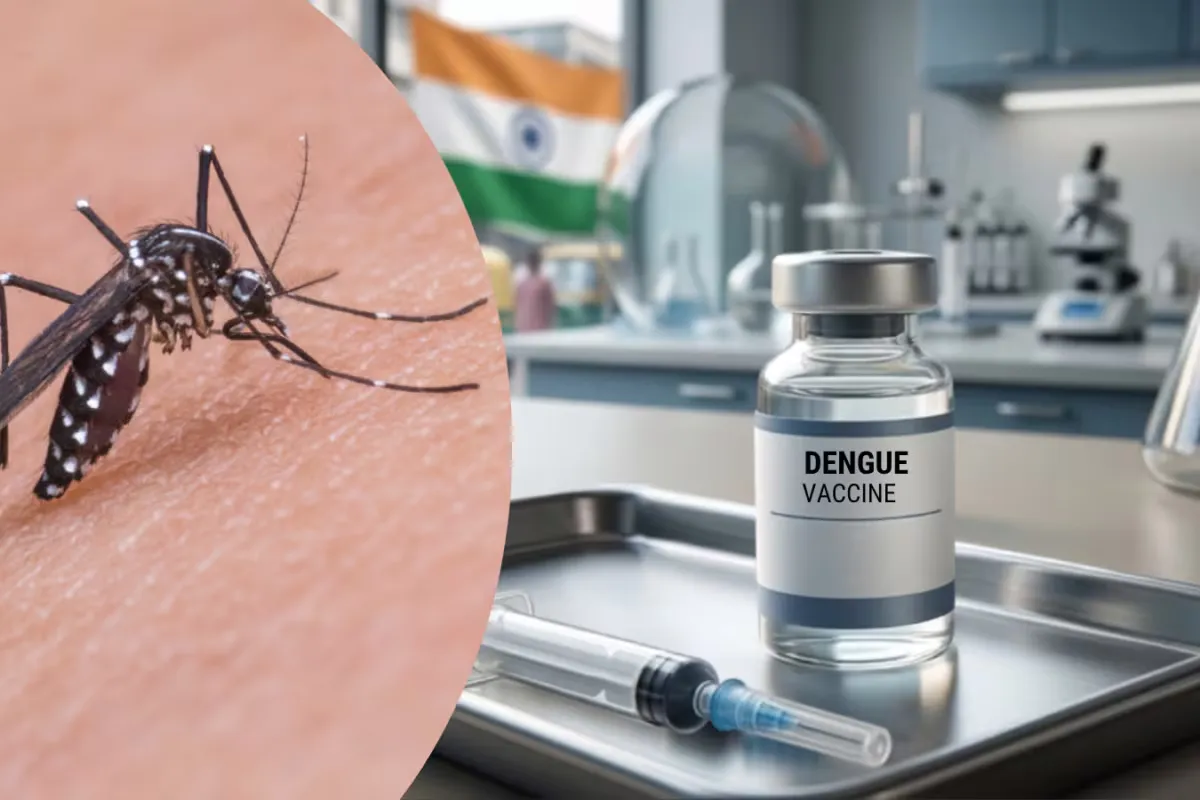
India is set to receive its first approved dengue vaccine in the first half of 2027. Following a distribution agreement between Dr Reddy’s Laboratories and Japan’s Takeda Pharmaceutical, the vaccine known as Qdenga will become available initially in the private market. This development marks a significant step in addressing one of the country’s most persistent mosquito-borne diseases.
What Is Qdenga?
Qdenga, also referred to as TAK-003, is a live-attenuated tetravalent dengue vaccine developed by Takeda. It is designed to protect against all four dengue virus serotypes — DENV-1, DENV-2, DENV-3 and DENV-4. The vaccine uses a weakened strain of the dengue virus type 2 as its genetic backbone. Structural proteins from the other three serotypes are engineered onto this backbone, allowing it to stimulate an immune response across the full range of dengue viruses circulating in India and other endemic regions.
Unlike some earlier dengue vaccine candidates, Qdenga does not require individuals to undergo blood testing to determine prior exposure to the virus before vaccination. This feature simplifies administration and makes it more practical for widespread use.
How the Vaccine Works
Qdenga works by safely mimicking a natural dengue infection without causing the disease. When administered, the attenuated viruses prompt the immune system to produce neutralising antibodies and cell-mediated defences against all four serotypes. Completing the full vaccination schedule is essential for optimal protection.
The recommended regimen consists of two doses of 0.5 ml each, given as subcutaneous injections three months apart. The vaccine is approved for individuals aged 4 to 60 years. Clinical data indicate that protection builds after the second dose and is sustained over several years.
Efficacy and Clinical Evidence
In a large late-stage clinical trial involving more than 20,000 participants across multiple countries, Qdenga demonstrated 80.2 per cent efficacy against laboratory-confirmed dengue cases one year after the second dose. It also showed 90.4 per cent efficacy against dengue-related hospitalisations after 18 months. Longer-term follow-up data indicate that protection against hospitalisation remains strong, with approximately 84 per cent efficacy observed after 4.5 years. Evidence of sustained safety and efficacy extends up to seven years across all four serotypes.
An additional Phase III study conducted in India among participants aged 4 to 60 years supported the vaccine’s safety and immunogenicity in the local population. The vaccine has received regulatory approval in 43 countries and holds World Health Organization prequalification, confirming it meets international standards for quality, safety and efficacy.
Regulatory Approval and Distribution Partnership
India’s Central Drugs Standard Control Organisation granted marketing authorisation for Qdenga in July 2026, making it the country’s first approved dengue vaccine. On September 18, 2026, Dr Reddy’s Laboratories and Takeda announced an exclusive agreement under which Dr Reddy’s will promote and distribute the vaccine in India’s private market for both paediatric and adult use.
Takeda retains rights for the public market, along with legal ownership and overall medical and brand oversight. Initial supplies for the Indian market are expected to come from Takeda’s manufacturing facility in Germany. Takeda has also partnered with Hyderabad-based Biological E to expand production capacity, with the goal of supporting up to 50 million doses annually from that collaboration and a combined global capacity target of around 100 million doses in the coming years.
Subject to completion of remaining local regulatory and quality processes, including import licensing, Qdenga is anticipated to become available in India during the first half of 2027.
Why Dengue Prevention Matters in India
Dengue remains a major public health challenge in India. The disease is transmitted primarily by Aedes mosquitoes and peaks during and after the monsoon season. Reported cases have risen sharply over the past two decades, driven by urbanisation, climate factors, changing mosquito habitats and population density. All four dengue serotypes circulate in the country, increasing the risk of severe disease upon secondary infection with a different serotype.
Until now, prevention has relied mainly on vector control measures such as eliminating breeding sites, using mosquito nets and repellents, and public awareness campaigns. The introduction of a vaccine adds a new preventive tool that can complement these efforts. While vaccination alone will not eliminate dengue while the mosquito vector remains widespread, it has the potential to reduce symptomatic infections and, more importantly, lower the burden of severe disease and hospitalisations.
Practical Considerations for Availability
The initial launch will focus on the private healthcare sector. Inclusion in India’s public immunisation programme remains a longer-term objective. Pricing details have not yet been announced. Access will depend on healthcare providers, awareness among clinicians and the public, and the ability of the distribution network to reach urban and eventually broader populations.
Healthcare professionals will play a key role in counselling eligible individuals about the two-dose schedule and the importance of completing both doses. Because the vaccine can be given without prior testing for dengue exposure, it offers greater flexibility than earlier options that required sero logical screening.
Looking Ahead
The arrival of Qdenga represents an important milestone in India’s dengue control strategy. It provides the first licensed vaccine option for a disease that affects millions and places recurring pressure on health systems during peak transmission seasons. Combined with continued investment in mosquito control, surveillance and community education, the vaccine has the potential to meaningfully reduce the human and economic costs of dengue over time.
As the 2027 launch approaches, attention will turn to final regulatory clearances, supply readiness, pricing transparency and public awareness. For families and individuals living in dengue-endemic areas, the prospect of an additional layer of protection against a disease long managed without a vaccine marks a tangible advance in preventive healthcare.
Read more – todaybestoffers.info