
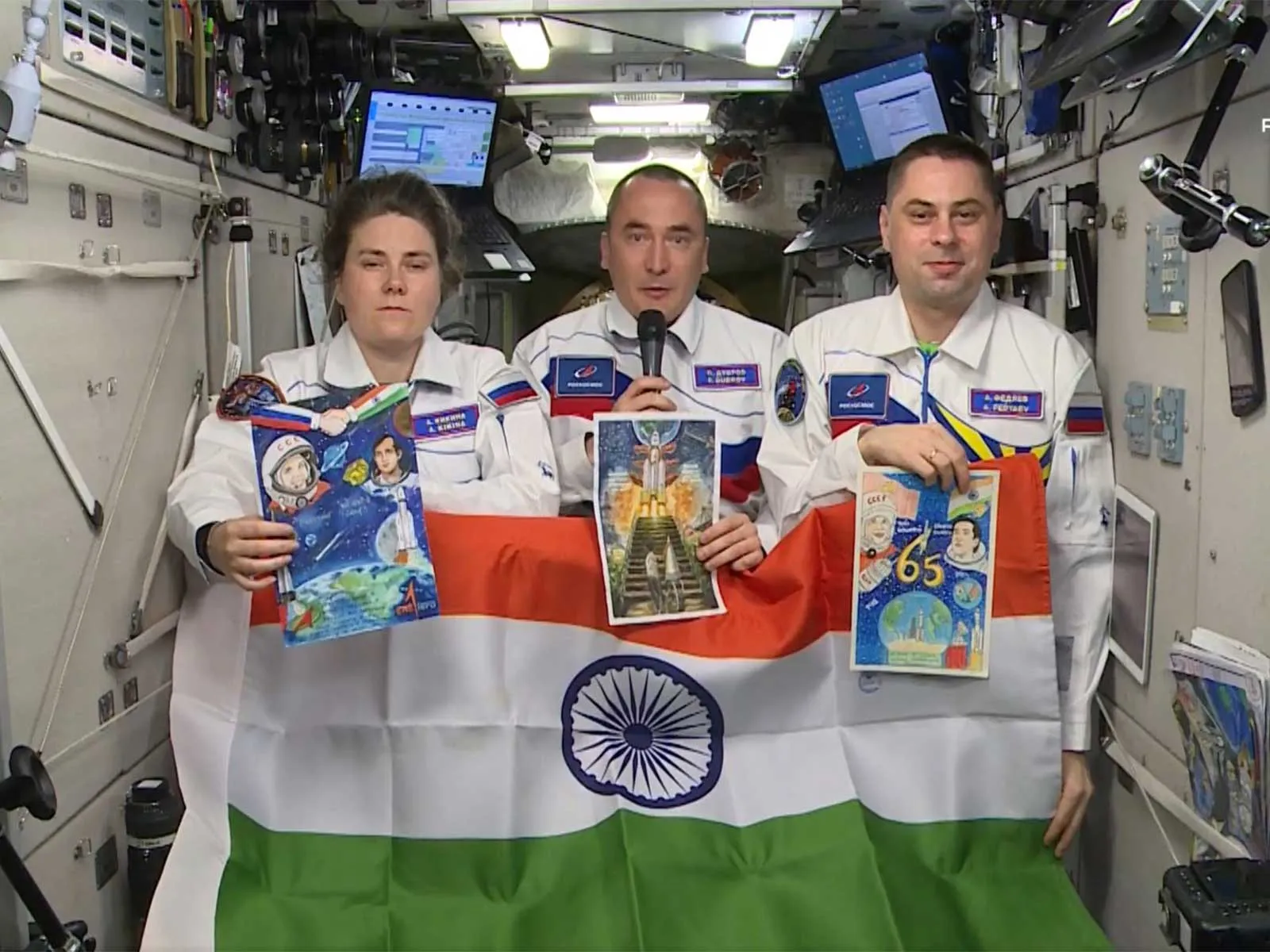
Russian cosmonauts aboard the International Space Station have sent warm Independence Day greetings to India, holding the national tricolour as they spoke. In a video message released ahead of the country’s 80th Independence Day, the crew congratulated the people of India, wished them peace and prosperity, and underlined the long record of cooperation between the two nations in space exploration. The gesture linked a national celebration on Earth with the continuing partnership that has stretched from the launch of Aryabhata to the preparations for Gaganyaan.
A Greeting from Orbit
The message was delivered from the Russian segment of the International Space Station. Cosmonaut Pyotr Dubrov addressed viewers directly: “Dear friends, today the Republic of India is celebrating its 80th Independence Day.” He extended wishes for peace and prosperity and noted that India had broken free from colonial rule to embark on a path of self-reliance and progress.
Towards the end of the recording, cosmonaut Andrey Fedyaev held the Indian flag and declared, “Long live India-Russia friendship.” The simple act of displaying the tricolour in microgravity gave the greeting a visual resonance that went beyond words. For many watching on the ground, the image of the national flag floating in the hands of Russian crew members aboard the station carried symbolic weight.
Space Cooperation as a Pillar of Friendship
The cosmonauts placed their greetings in the longer arc of bilateral space collaboration. They recalled that the partnership dates back to 1975, when the Soviet Union launched Aryabhata, India’s first satellite. That mission marked the beginning of practical cooperation in space technology and gave India an early foothold in orbital science.
Nearly a decade later, in 1984, Rakesh Sharma became the first Indian to travel into space, flying aboard the Soviet spacecraft Soyuz T-11. His mission remains a landmark in the shared history of the two countries and an enduring source of national pride in India. The cosmonauts also connected the present moment to the 65th anniversary of Yuri Gagarin’s pioneering flight in 1961. They noted that Gagarin had visited India later that same year and had spoken warmly of the country, an early personal link between Soviet space achievements and Indian public imagination.
Looking forward, the message acknowledged India’s human spaceflight programme, Gaganyaan. The reference positioned current cooperation as a continuation of the same relationship that began with satellites and the first Indian cosmonaut, now moving toward independent Indian crewed missions with Russian technical engagement in specific areas.
Symbolism and Timing
Independence Day messages from space are relatively rare. By choosing to mark India’s 80th Independence Day with a formal greeting and the display of the tricolour, the Russian crew turned a routine commemorative occasion into a visible affirmation of partnership. The timing, shortly before 15 August, ensured the message would form part of the broader national conversation around the anniversary.
The cosmonauts also referred to a joint competition organised by Roscosmos, its representative office in India, and the Indian Space Research Organisation. Winning entries from that contest were presented alongside the Independence Day greeting, adding a participatory dimension that involved students and space enthusiasts on the ground.
Continuity Across Decades
India-Russia space cooperation has never been limited to a single project. It has included satellite launches, astronaut training, technology exchanges, and mutual support in international forums. Even as India’s space programme has grown more self-reliant and diversified its international partnerships, the historical and technical links with Russia have remained significant.
The Aryabhata launch demonstrated early trust and capability-sharing. Sharma’s flight gave India its first human spaceflight experience under Soviet arrangements. Subsequent decades saw continued collaboration on remote sensing, launch services and scientific experiments. The current phase, which includes elements of support for Gaganyaan, extends that thread into the era of independent Indian human spaceflight.
The ISS message therefore served a dual purpose. It offered conventional festive greetings. At the same time, it reminded audiences that the relationship has concrete technological content and a continuous timeline measured in decades rather than isolated events.
Public Diplomacy in Orbit
Gestures from the International Space Station carry a particular form of soft power. The station itself is a multinational laboratory, yet national crews frequently use it to communicate with home audiences and partner countries. By addressing India specifically and holding the national flag, the Russian cosmonauts performed an act of public diplomacy that required no formal treaty language. The visual of the tricolour in orbit, paired with spoken wishes for peace and prosperity, communicated continuity and goodwill in an accessible way.
For India, the message arrived at a moment when the country is preparing to celebrate eight decades of independence while simultaneously advancing an ambitious space agenda. The combination of national anniversary and space partnership gave the greeting added resonance.
Looking Ahead
As India moves closer to its first crewed Gaganyaan mission and continues to expand its satellite and exploration capabilities, international partnerships will remain relevant. The Russian cosmonauts’ message did not announce new agreements. It simply reaffirmed that the historical relationship retains contemporary meaning.
The closing words spoken while holding the Indian flag—“Long live India-Russia friendship”—captured the tone of the entire communication. Delivered from the unique vantage point of the International Space Station, the greeting linked a national celebration on Earth with a partnership that has already spanned satellites, the first Indian in space, and the shared horizon of human spaceflight. In doing so, it turned a ceremonial occasion into a quiet reminder of how far the two countries have travelled together among the stars.
Read more – mesmerizemovies.com