
The Partition drama Batwara 1947 opened on 14 August 2026 with high expectations. Directed by Rajkumar Santoshi, produced under Aamir Khan’s banner, and starring Sunny Deol alongside Preity Zinta and Shabana Azmi, the film reunited Deol with the filmmaker after earlier collaborations. Yet its theatrical run remained modest, with collections reported in the range of Rs 50–54 crore against a substantially higher budget, while another release on the same day performed far more strongly. Veteran actor Shabana Azmi has since offered one explanation for the commercial shortfall: audiences found it difficult to accept Sunny Deol in a Muslim role.
Azmi’s Assessment of the Response
In a recent conversation, Azmi expressed surprise at the gap between the praise she heard from people who watched the film and its limited footfalls. Many, she said, appreciated the message of humanity and considered it relevant. At the same time, large sections of the public stayed away, and some who did attend left with mixed or confused reactions.
She linked part of the difficulty to casting. “The thing is that you cannot accept Sunny Deol as a Muslim,” she observed. Azmi contrasted this with earlier decades when Amitabh Bachchan played Muslim characters in films such as Coolie and appeared with visible Islamic markers in Deewaar without apparent resistance from audiences. She questioned what had changed and whether the current environment made such casting decisions harder to accept.
Azmi also noted that some viewers misread the character entirely, believing Deol was portraying a Pakistani rather than an Indian Muslim. The actor plays Sikander Mirza, a Muslim from India who is displaced during the violence of Partition and migrates to Lahore. Director Rajkumar Santoshi has repeatedly clarified this distinction, emphasising that the character is Indian by origin and forced across the new border by circumstances.
The Film and Its Ambitions
Batwara 1947 is adapted from Asghar Wajahat’s well-known play about an elderly Hindu woman who remains in her Lahore home after Partition while a Muslim family from the other side of the border is allotted the property. The story explores displacement, shared humanity and the human cost of communal division. Shabana Azmi plays the Hindu widow, while Deol leads the Muslim family that arrives as refugees.
Santoshi has acknowledged that casting Deol in the role was viewed as risky from the outset. Industry investors, he recalled, preferred the actor in familiar action-oriented parts and were hesitant about a narrative centred on an Indian Muslim protagonist in a Partition setting. The project ultimately moved forward with Aamir Khan’s support. Santoshi has described the casting choice as intentional, aimed at subverting audience expectations around Deol’s established screen image.
Other Factors Cited by Trade Observers
Commercial analysts have pointed to several additional reasons for the film’s limited theatrical success. Deol’s long-standing association with assertive, action-driven roles in films dealing with conflict created a mismatch for some viewers when he appeared in a more restrained and dramatic register. Although the film contains moments of intensity, its overall tone and emphasis on reconciliation differed from the high-energy confrontations many associates with the actor.
The film’s central theme of inter-community harmony and shared suffering was also described by some exhibitors as out of step with the prevailing public mood, which they characterised as more confrontational. One trade observer remarked that the film was “trying to swim upstream” while another release on the same weekend aligned more closely with current audience preferences and therefore performed better.
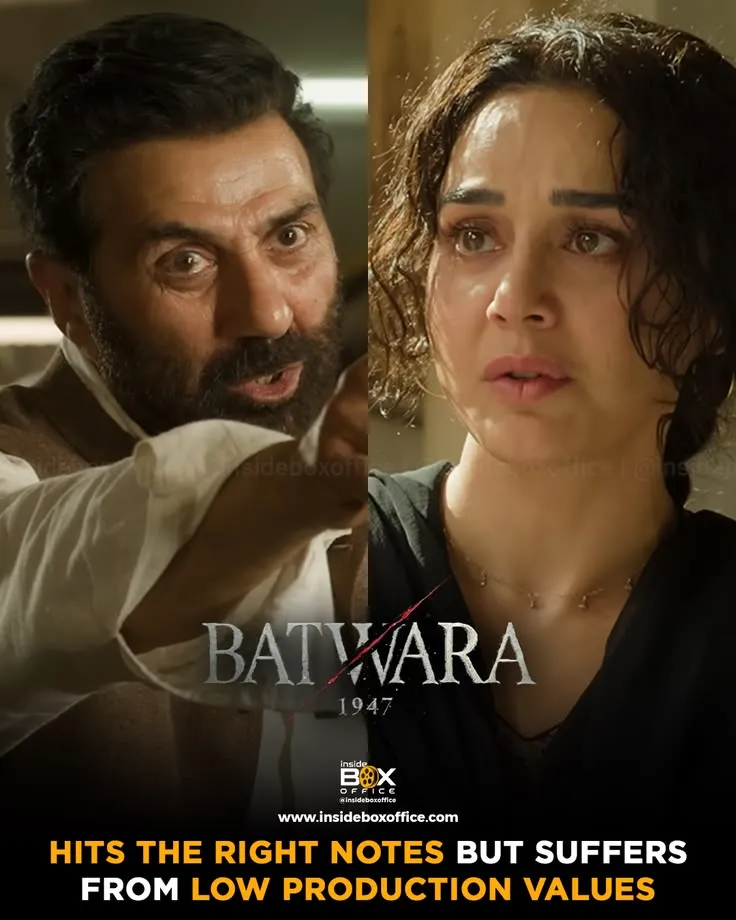
Budget considerations added pressure. Reports placed the production cost well above Rs 100 crore. Recovering such an investment required strong and sustained footfalls that did not materialise after the Independence Day weekend spike. Word of mouth, while positive among a section of viewers, did not translate into the broad theatrical urgency needed for a large-scale period drama.
Reception and Critical Response
Critical reaction was mixed. Some reviewers praised the performances, particularly the emotional interplay between Deol and Azmi, and appreciated the film’s attempt to present a humanistic counter-narrative to more polarised historical storytelling. Others found the treatment dated or overly didactic, arguing that the message was stated rather than fully dramatised. The result was a film that earned respect from certain quarters without generating the widespread enthusiasm required for commercial success.
The simultaneous release of a more mainstream entertainer further fragmented the available audience. Holiday weekend openings provided a temporary lift, but collections declined sharply on subsequent weekdays, a pattern typical of films that fail to convert initial curiosity into sustained interest.
Image, Casting and Audience Expectation
Sunny Deol’s screen persona has been shaped over decades by roles that project strength, patriotism and direct confrontation. When an actor so closely identified with one kind of narrative appears in a markedly different register, audience acceptance is never automatic. Azmi’s comparison with Bachchan underscores how star images evolve and how the same casting choice can succeed or struggle depending on the cultural moment.
Santoshi and the makers have maintained that the character is an Indian Muslim displaced by Partition, not a Pakistani antagonist. The persistence of the opposite reading among some viewers suggests that promotional framing, existing star associations and the charged nature of Partition narratives all influenced reception.
A Film That Found Appreciation Without Scale
Batwara 1947 did not lack pedigree, craft or a serious thematic intent. It brought together a major star, an experienced director, a respected literary source and a producer known for ambitious projects. What it lacked was the broad theatrical conversion that turns critical or selective praise into commercial momentum.
Shabana Azmi’s remarks highlight one widely discussed element—the difficulty some audiences experienced in accepting Sunny Deol as a Muslim character—while trade commentary points to image mismatch, thematic positioning, budget scale and competition as concurrent factors. Together they explain why a film that resonated with those who saw it still struggled to fill seats in sufficient numbers. The episode illustrates the complex interplay between star image, historical subject matter and contemporary audience sentiment in determining theatrical outcomes.
Read more – Instantdua.com